How to cut your trade show costs
Where trade show money leaks and how to spend less without vanishing from the aisle: the full bill, the audience, the booth, the team and the truck.
 By Tesseract 3D MarketingPublished on 5 min read
In 30 seconds
- Floor space is only one line: a trade show costs the space, the booth build, the freight, the team and their time away, all added together.
- You can spend less by choosing shows for their audience and agreeing the booth early, with a structure that comes back.
- Whatever goes on the truck tends to be the most expensive line on the bill and the one nobody questions.
In this article
Anyone who exhibits knows the moment. The show is over, the booth has come down, and the cost spreadsheet lands before any of the contacts have turned into orders. At the next meeting the question is rarely “was it worth going?” Usually it’s “why did it cost so much?”
The answer is almost never a single line. An expensive trade show is built from lots of small decisions, made by different people at different times. If you want to spend less without disappearing from the aisle, you have to look at all of them together.
Start with the full bill
Floor space is the figure everyone remembers, because it’s the first invoice. It’s usually only part of what the show costs. Before you cut anything, put together the full bill for the last edition:
- floor space and the organiser’s fees;
- booth design, build and teardown;
- freight both ways, with insurance;
- flights, hotels and meals for the team;
- brochures, gifts and whatever you run on the booth;
- the working days of everyone who was away from the office.
That last line is the one almost nobody writes down, and sometimes it’s the biggest. An applications engineer who spends the week on the booth is a week with no customer calls, no site visits and no proposals going out.
Once the whole bill is on the table, it becomes obvious where to act. Quite often floor space isn’t the problem at all.
Pick the show for its audience, not its size
A big show gets attention, but attention doesn’t pay the bill. What pays is meeting the people who buy what you sell, in the aisle. Before you rebook a show, ask your sales team: how many conversations from the last edition became real opportunities? Who were those people?
Sometimes the answer shows that a smaller, more specialised show brings the same number of good conversations for a fraction of the effort. Sometimes it shows the big show is worth it, just not with the big booth. Either answer saves money.
Exhibiting at a trade show? Ask for an analysis of your equipment.
Send the 3D file or photos and the event date. The analysis tells you the scale, what becomes a module and what is ready before shipping.
Agree the booth early, and for more than one show
The booth is where the budget slips most, because every last-minute change is expensive. The conversation with the booth builder goes very differently when it starts early. A tight deadline takes away your room to negotiate and pushes everything towards the priciest option still available.
It’s also worth asking for a booth that comes back. A modular structure designed for more than one show spreads the design cost across the year’s events. The graphics change and the structure stays.
And close the brief before anyone starts drawing: how many people will be talking to visitors at once, whether there will be seated meetings, what has to be visible from the aisle. Every change after the design is approved turns into an extra on the invoice.
Send fewer people, better prepared
A booth packed with your own staff doesn’t look strong. To someone walking past, it looks like a closed circle. Two or three well-prepared people do a better job than a whole team without a plan.
Preparing is simple and hardly ever done. Decide who approaches visitors, who takes the technical conversation further, how each contact gets logged and who follows up afterwards. A smaller team with clear roles spends less on travel and comes back with better notes.
Measure what came back
A trade show is only expensive or cheap relative to what it brought back. Without measuring, next year’s decision turns into a matter of opinion. For each contact, record where it came from, what they asked for and where things stand a few weeks later. Then the next bill starts with a better question: what did each real opportunity cost?
That record also protects the budget inside the company. A show that brings in orders is much easier to defend when the orders are written down.
Rethink what goes on the truck
That leaves the line fewest people question: taking the equipment. If you sell machines, systems or production lines, showing the product feels mandatory. But the real product is heavy, fills the whole booth and needs special freight, insurance, a technician to set it up and sometimes sign-off from the organiser. Then it goes back to the factory the same way, at the same cost.
There are ways to show the product without hauling it. A short, well-made video built around the problem the machine solves holds attention on the big screen. A cutaway, a detail part or a sample of what the machine produces fits on a table.
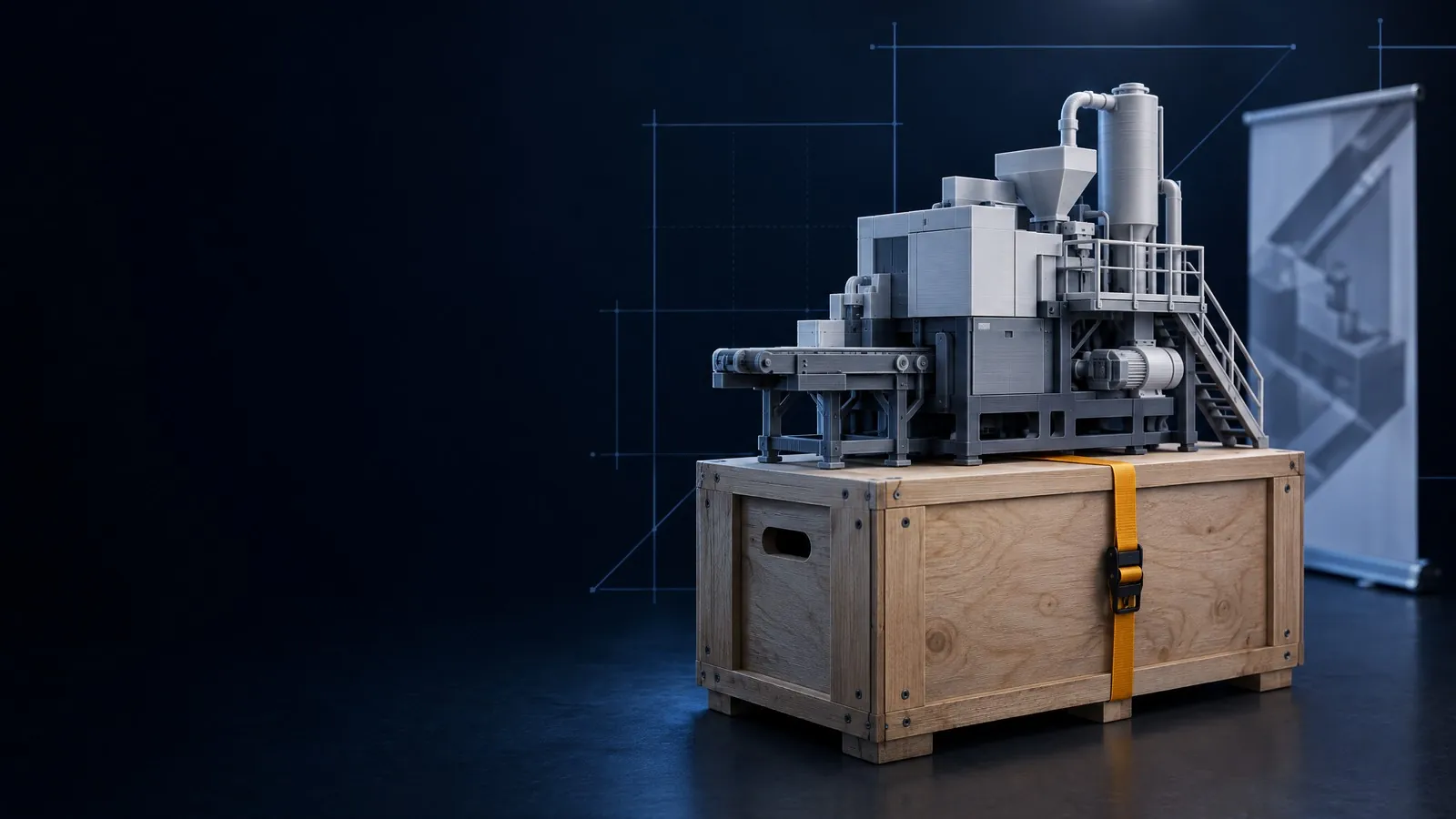
And there is the industrial scale model: the whole machine, to scale, true to the engineering design, painted in your brand colours. It shows what the machine is inside and out, lets visitors point at the component they care about, can travel in modules and comes back for the next show without special freight. When the machine is big, this is usually the swap that moves the bill most, because it removes the freight, the insurance and the floor space the machine used to take up in one go.
If your next show already has a date, have a look at scale models for trade shows and events and send your booth dimensions to Tesseract for a technical analysis.
Frequently asked questions
Is it worth taking the real equipment to the show?
It is when visitors need to see the machine running and the booth can take its weight and footprint. When what sells is the inside, the scale of the plant or a comparison between models, a scale model shows more and travels in a crate.
How far ahead should I order the scale model?
Put the event date and the date the freight leaves in your request. The technical analysis tells you whether the window works and what to adjust: scale, level of detail or splitting into modules.
Can the scale model be used after the show?
Yes. The same piece can go on sales visits, into the training room or into your company's reception.
Do I need a 3D file of the equipment?
It helps, but it isn't required. The file can be STL, STEP or OBJ. Without one, photos and measurements are a starting point.