Why invest in industrial 3D printing?
What industrial 3D printing does for cost, prototyping and spare parts, where it fits in a factory, and what it takes to bring it into your processes.
 By Tesseract 3D MarketingPublished on 6 min read
In 30 seconds
- Printing parts on demand cuts stock, transport and wasted material.
- A printed prototype puts an idea in your hands long before a tooled part would.
- Bringing it in means winning people over, training the team and fitting it into the processes you already run.
In this article
A lot of factories now treat 3D printing as an ordinary option. The machines keep getting better, and the technology gives companies another way to make parts and prototypes, often for less money and in less time. So why pay for a 3D printing service? Here are the benefits, where it applies in industry, what tends to get in the way, and what it does to the numbers.
Key takeaways
- 3D printing lowers cost and makes production more efficient.
- It gives you flexibility and lets you make parts to fit a specific need.
- The usual obstacles are resistance to change and the need for training.
Benefits of a 3D printing service in industry
Lower operating costs
Printing parts on demand means you don’t have to hold large stocks. Transport and storage costs fall too, because a part is made when it’s needed instead of being shipped in and shelved. An additive process only uses the material that goes into the part, and some of the leftover can be reused, so there’s less scrap.
Faster prototyping
Prototyping is where 3D printing is hardest to beat. It turns an idea into a physical model long before a machined or moulded part would be ready, so you can test, adjust and test again without waiting on tooling. Each round costs less, and problems turn up while they’re still cheap to fix.
Parts made to fit
Customisation is one of the main draws. A company can offer parts and products built to a customer’s exact requirement, and that opens up work a standard catalogue can’t reach.
Leaner production processes
3D printing slots easily into a digital manufacturing workflow: the CAD file goes straight to the printer. It also makes shapes that would be impossible, or far too expensive, with traditional methods. You get lighter, more efficient parts and a shorter road to market.
Where 3D printing fits in industry
Automotive
Carmakers and their suppliers use 3D printing to get complex and custom parts quickly, prototypes of engine components and fittings above all, which would otherwise need tooling. In the automotive industry that shortens the prototype cycle, cuts cost and makes tests more reliable, because the team checks a real part instead of a drawing.
Machinery and equipment
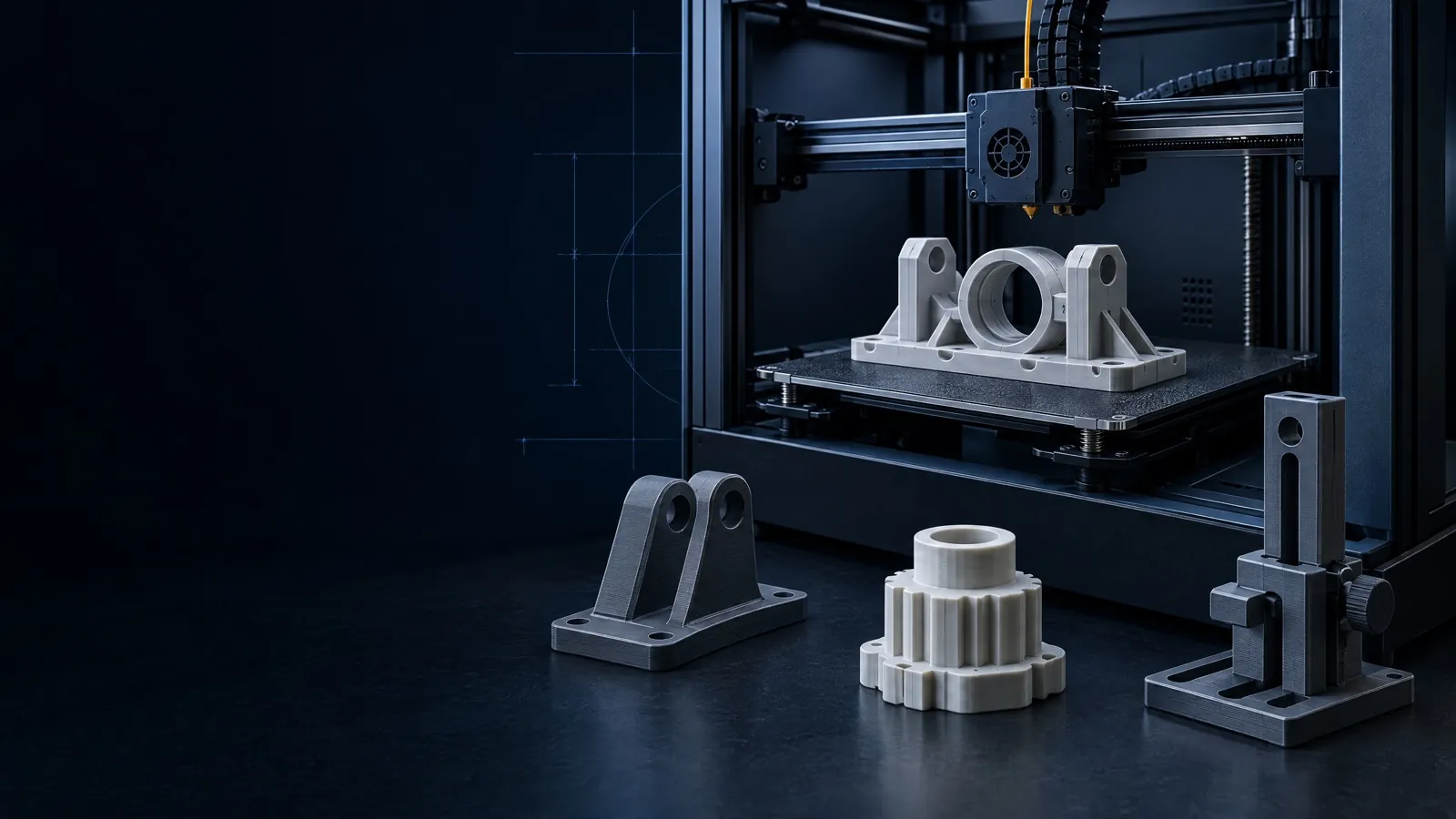
Equipment makers have the same need on a different scale. A new housing, a bracket or a guard can be printed and tried on the machine before anyone commits to a mould or a machining run. Complex shapes come out as one piece, with less material wasted along the way.
Scale models for training and sales
The same printers that make prototypes also make industrial scale models. A model of a crusher, a pump or a whole production line lets a new operator see inside equipment that can’t be stopped or opened, and lets a sales team put a machine on the table that is far too big to carry. More on models for training and for sales demonstrations.
Want to try 3D printing on a real project?
Send the 3D file or photos of the part. The technical analysis tells you whether 3D printing fits, and with which process and material.
Challenges of bringing 3D printing in, and how to handle them
Resistance to change
People push back on most new technology, and 3D printing is no exception. Managers and staff can be reluctant to drop methods they trust for something that hasn’t been tried much in their industry. The way past that fear is a gradual, well-planned rollout that shows real gains over time.
- Explain clearly what 3D printing will change and what it won’t.
- Run hands-on demonstrations that show the improvement on a real process or product.
- Ask the people using it for feedback and adjust as you go.
Training
Training is the other big hurdle. Running and maintaining 3D printers takes skills that the current workforce often doesn’t have. It pays to:
- Run regular training so everyone involved keeps up with the technique.
- Work with technical schools and colleges on specialised courses.
- Offer refresher programmes to staff who already have some technical background.
Fitting it into existing processes
Adding 3D printing to an established production line can be awkward. The new technology has to slot in and improve the workflow you already have. A few ways to do it:
- Map the current processes in detail to find where printing fits.
- Adapt software and tools so they work together.
- Run a pilot before a full rollout.
Company culture
Culture can be the strongest brake of all. In many companies, the way things have always been done resists anything new. To get past that:
- Make room for new ideas with workshops and internal events.
- Recognise and reward the people who find good uses for 3D printing.
- Keep the conversation open, so concerns get raised and dealt with.
Making 3D printing work is as much about people and processes as it is about machines. Handle these four points with a clear plan and it can become a real edge over competitors.
The economic impact of a 3D printing service
Less waste
3D printing helps cut waste on production lines. Parts are made to size, so less material goes in. And because a design can be changed quickly, a factory avoids building up obsolete or faulty stock.
Production on demand
With 3D printing, making to order becomes practical: you produce what’s needed, when it’s needed, without large stocks. That saves money twice, on storage and in the flexibility to meet a specific customer request.
Spare parts
Printing spare parts reduces your dependence on the original supplier and its lead times. A complex component can be made when the machine needs it, which saves time and money and gets the line running again sooner after a breakdown.
Competitiveness
Companies that adopt 3D printing can try new ideas quickly and tailor products to what the market asks for, which helps them stand out in crowded sectors. It also makes room for new business models.
Adopting 3D printing has less to do with following a trend than with economics. Less waste and leaner production add up, and over time that shows in how you compete.
If you want to see what 3D printing could do for your company, send us the part or the project.
Conclusion
For an industrial company, 3D printing is now a practical tool rather than an experiment. It lowers cost and speeds things up, and the complex, made-to-fit parts it makes can open up new business. Investing in it is a sensible way to stay competitive, and the first step can be a small trial on a real part.
Frequently asked questions
What is 3D printing and how does it work?
3D printing builds a physical object from a digital model. The process is called additive manufacturing: material goes down one layer at a time until the part is complete.
What are the main benefits of 3D printing in industry?
Lower cost on prototypes and short runs, faster prototyping, parts made to fit a specific need, and leaner production. You stop paying for tooling and stock you may never use.
Which sectors can use 3D printing?
Almost any company that designs, builds or maintains physical equipment. In industry the usual uses are prototypes, spare and custom parts, jigs and fixtures, and scale models of machines and plants for training and sales.