The future of the industrial scale model
What 3D printing is changing in industrial scale models: new tools and materials, gains and limits, and how a model goes from CAD file to finished piece.
 By Tesseract 3D MarketingPublished on 8 min read
In 30 seconds
- AI-assisted design, augmented reality and automation are starting to change how industrial scale models are designed and presented.
- Tougher materials and higher-resolution printers give the printed parts finer detail.
- The process runs from CAD modelling to a quick physical prototype, then rounds of review until the final version.
In this article
- What to take away
- How 3D printing changed industrial model making
- New technology in the workflow
- Advances in technology and materials
- What 3D printing brings to industrial scale models
- Challenges and how to deal with them
- 3D printing in reverse engineering
- What a scale model does for industrial planning
- How an industrial scale model is made
- The future of 3D printing for industrial scale models
- Conclusion
- Frequently asked questions
3D printing has changed how industrial scale models get made. It brings gains in cost, time, precision and design freedom, and new materials and software keep pushing it further, in the automotive industry as much as anywhere else. This article looks at what is new, where the limits still are and how a model is actually built.
What to take away
- Printing makes scale models more precise and more detailed, so an industrial project is easier to read.
- AI and augmented reality are being added to the design and presentation side of the work.
- More sustainable materials are becoming common, which makes the manufacturing side more responsible.
- Lead times come down because the process has fewer steps between the file and the model.
- The workflow itself is simple: model, print, review, adjust.
How 3D printing changed industrial model making
Printing changes how a model is designed, prototyped and made. A model can be produced locally and on demand, so it no longer has to pass through a long chain of suppliers before it reaches the meeting room.
New technology in the workflow
The tools around printing move fast, and anyone who works with industrial scale models has to keep up. Two of them stand out right now: artificial intelligence for refining designs and augmented reality for showing them. Both make the process more efficient, and both let the client take part in it instead of waiting for a finished object.
These are trends in the field, not a list of services. What follows is what each one does.
AI for refining designs
AI tools suggest more efficient designs and let the digital model be adjusted quickly before the final print. Refining on screen saves time and material that a reprint would cost.
Augmented reality for showing models
Augmented reality places a model in a real space, on a tablet or a headset. Teams and clients understand the project faster when they can walk around it, and the conversation between them gets easier.
Automation in printing
- Less hands-on intervention means fewer human errors and more consistent precision.
- Production runs faster, so delivery can come sooner.
- Automated workflows can feed on AI tools to plan the work better.
Advances in technology and materials
Printing has moved quickly, and the models show it. The quality is higher and the production is faster than it was a few years ago.
New sustainable materials
The range of printing materials keeps getting wider. Today it includes:
- Materials made to reduce environmental impact.
- Biodegradable polymers.
- Composite materials that are stronger and lighter than the plain plastic.
They answer a real demand from industry for less wasteful options.
Higher-resolution printers
Modern printers are more precise every year. In practice that means:
- Models come out with finer detail.
- Printing takes less time.
- The printed parts are noticeably better.
High-flow filaments have also improved a lot. They print faster, which makes the technology more practical for everyday jobs.
What 3D printing brings to industrial scale models
Precision and detail
Complex details come out exactly as designed. When a team is analysing a project and looking for improvements, it needs every element to be visible and correct, and the printed model gives it that.
Shorter lead times and lower cost
Printing speeds up development. Companies see their project in physical form early and adjust it quickly, so the whole cycle of reviewing a design gets shorter.
Freedom to customise and prototype
Designers can change the model quickly and print the new version. That makes it possible to test functional prototypes while the project is still moving, instead of after the decisions are made.
Does your project already have a 3D file?
Send it as STL, STEP or OBJ, or send photos and measurements if you don't have one. The technical analysis comes back with the scale, the material and the lead time.
Challenges and how to deal with them
Printing has its own technical problems. Here are the main ones and what helps.
Technical barriers
The usual obstacles are:
- Reproducing very fine details accurately.
- Handling different materials that behave differently and can affect quality.
- Modelling software that is not always up to the job.
What helps is better printers, better digital modelling and testing the models regularly to keep the quality up.
Keeping the quality up
Three habits make the biggest difference: picking the right material for each type of project, reviewing and adjusting during printing, and getting the design and engineering people to work on the model together.
Choosing among many materials
There are a lot of printing materials, and picking the right one matters. Some points to weigh:
- Durability: PETG is tough and suits models that will be handled a lot.
- Surface quality: the material changes how the finished model looks.
- Cost: quality and price have to be balanced.
Where the opportunities are
The market for 3D printing keeps growing. In the automotive industry it is used for made-to-measure parts and fast prototypes, and personalised, on-demand production is changing how other industries make things too.
3D printing in reverse engineering
Printing is a practical tool in reverse engineering, where an existing part has to be recreated accurately.
Scanning the part
3D scanning is the first step. A good 3D scanner, chosen for the job at hand, captures every detail of an existing part and turns it into an accurate digital model for analysis and reproduction.
Rebuilding the model
Once scanned, the part is rebuilt on screen. Faults show up and improvements can be made before anything physical exists. Then printing turns the model into a part that can be tested and checked, quickly.
Continuous improvement
Because a new print is cheap, the model can keep being adjusted. In industrial work, where precision and efficiency both count, being able to iterate fast is how the final part ends up meeting every technical requirement.
What a scale model does for industrial planning
A detailed model, produced quickly, changes how a project gets planned. Companies use it to:
- Evaluate the project more efficiently.
- Make adjustments before execution.
- Cut operating costs.
The model also does work outside the planning room. It explains a process in training, and it stands in for the real equipment at trade shows. The gain is clarity: decisions are easier when everyone is looking at the same object, and so is the conversation between the team and the client.
How an industrial scale model is made
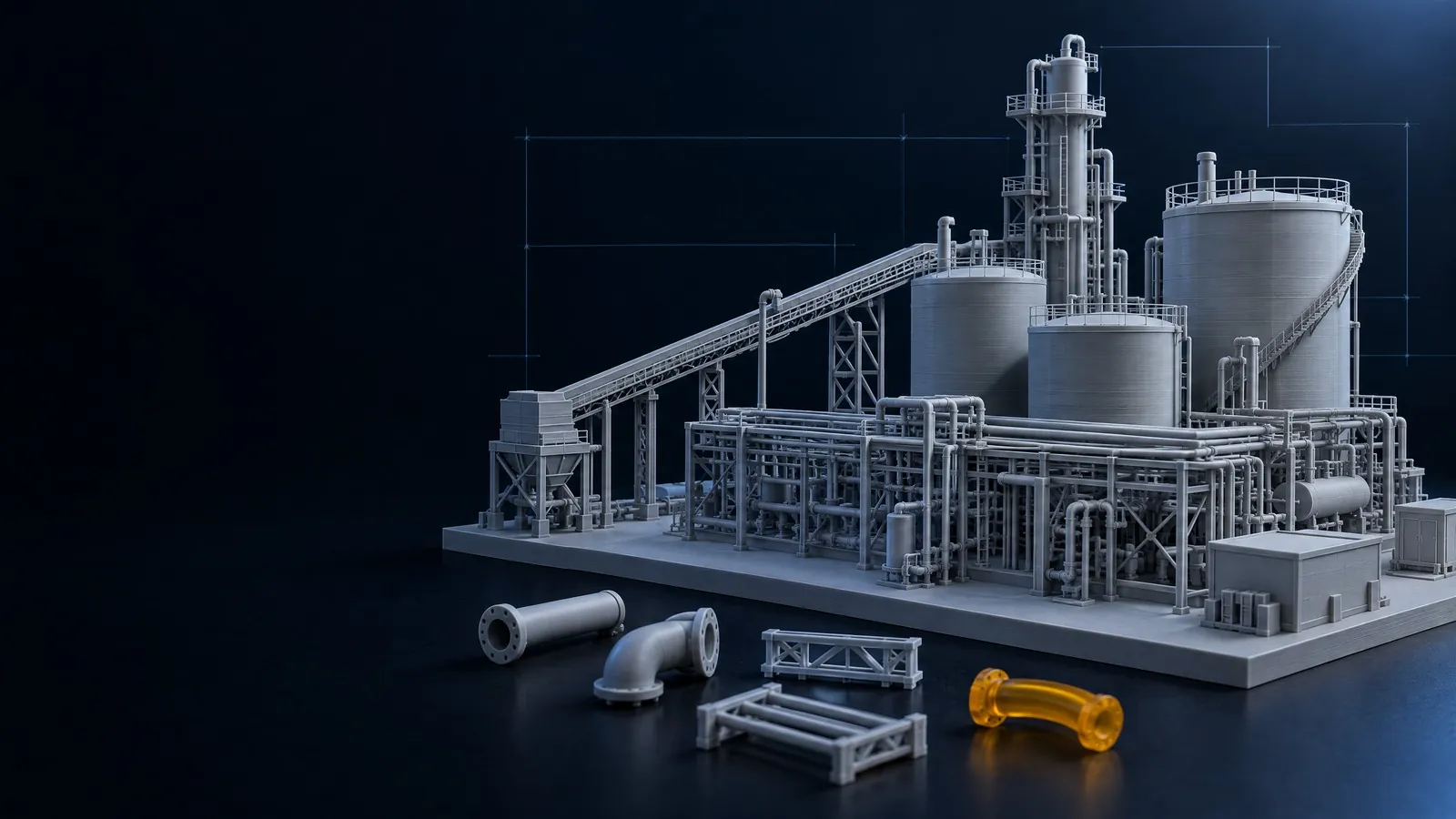
Building a scale model with 3D printing goes through a few stages, and each one protects the quality of the final piece. Printing also works at almost any scale, from a very detailed miniature of a single machine to a larger model of a whole plant.
Digital modelling in CAD
The first step is the digital model, drawn in CAD (computer-aided design) software. Accuracy at this stage, and the ability to make quick changes, decide how good the final model will be.
Rapid prototyping and testing
Next comes a rapid prototype: a physical version of the design, made in a short time. It shows whether the design works and what needs to change before the final print.
Reviews and adjustments
Then the reviews. Each round improves some part of the project, and the designers and engineers feed their comments back into the model until it is right.
The steps in short
- Digital modelling: the design is drawn in CAD.
- Rapid prototyping: a physical version is printed for testing.
- Reviews and adjustments: the model improves with each round of feedback.
Follow these steps and the final model does what the project needs it to do. The industrial scale model guide covers what to send and how to choose.
The future of 3D printing for industrial scale models
Emerging trends
3D printing keeps evolving and opening new options for industrial scale models. Expect companies to adopt more advanced techniques and more sustainable materials, with an eye on environmental responsibility as well as efficiency. AI could refine designs and production processes further still.
Research and development
The growth of the 3D printing market has pulled money into new technology. Companies are working on more precision and more speed, which brings models closer to being true replicas of the industrial project, with fine detail and high fidelity.
A growing market
Demand for 3D-printed industrial scale models is growing, driven by the need for fast, efficient prototyping. Three things are behind it:
- New technology: companies are investing in high-resolution printers and new materials.
- Sustainability: greener materials are becoming a priority.
- Interactivity: augmented reality is being added to how models are presented.
Conclusion
3D printing has changed the way industrial scale models are made. Detailed, accurate models now take less time, which helps companies plan their projects better and explain them more clearly to their clients. They also save time and money, because a project is easier to see and adjust when it sits on the table. As the technology moves on, it will stay one of the most useful tools for manufacturing and for innovation in industry. If you have a project in mind, the industrial scale model service is where to start.
Frequently asked questions
What is 3D printing of industrial scale models?
It is a way of building a physical model of an industrial project straight from its digital model. Holding the model makes the planned structure much easier to understand than a drawing on a screen.
What are the advantages of 3D printing for scale models?
High precision, lower cost, shorter production time and the freedom to change or customise the model without starting again.
How does 3D printing help optimise a project?
Design problems show up on the model before anything is built, so they get fixed early, when fixing them is still cheap.
Which materials are used to 3D print scale models?
It depends on how strong and how detailed the model has to be. Plastic filaments and photopolymer resins are the usual choices; metal printing exists, but it is aimed at functional parts rather than models.
How does 3D printing affect model revisions?
Revisions get easier because people review a physical object. Gaps and possible improvements are far easier to spot on the model than on a screen.
How is 3D printing changing the future of industrial scale models?
It keeps bringing new materials and new ways of working, which widens the room for customisation and raises the quality of the finished model.
What role does 3D printing play in reverse engineering?
It turns a scanned and rebuilt digital model back into a physical part, so the part can be checked, improved and tested again.